Standby Generator Running With Power On? Here’s Why
If your standby generator runs even when utility power is on, it’s a warning sign. Learn common causes, safe shutdown steps, and when to call a professional.
When Your Standby Generator Runs While Power Is On
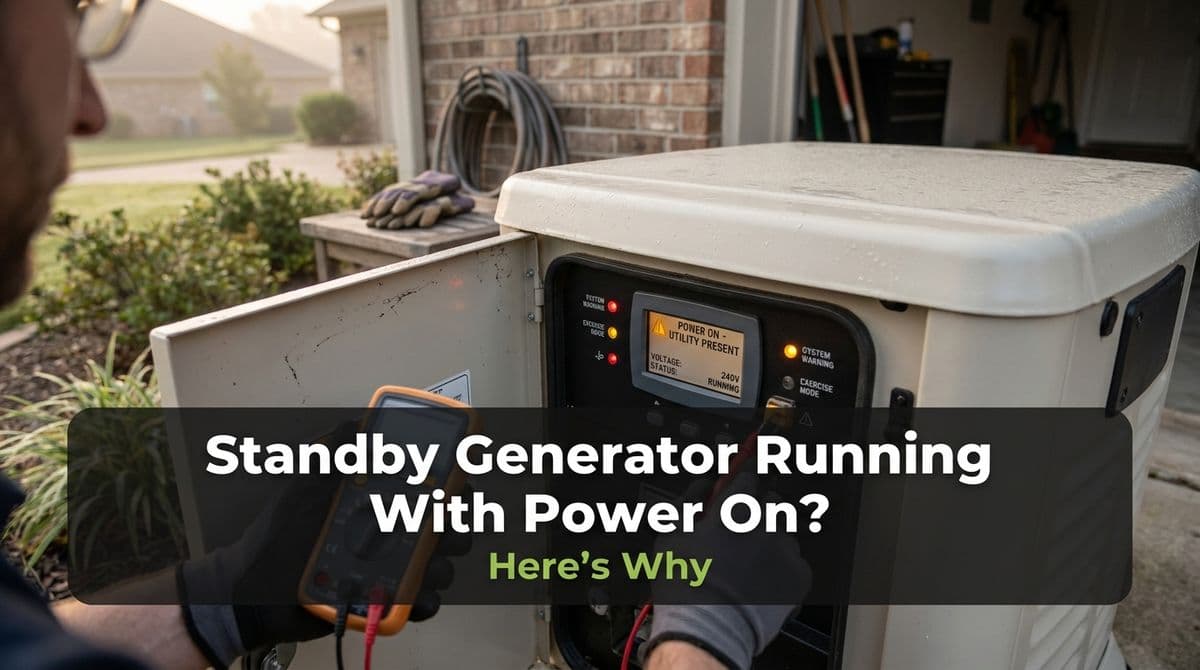
We recently got a call from a homeowner — let’s call him Tom — who was pretty frustrated with his standby generator. His power was on, the house lights were working just fine, but the generator suddenly started up and kept running like the power was out.
Tom walked outside, hit the STOP button on the generator, and it shut down… only to immediately switch itself back to AUTO/START and fire right back up. The only way he could get it to stay off was to pull the battery cable.
If that sounds anything like what you’re dealing with, you’re not alone. We see this scenario a lot with home standby generators, and it can be both annoying and potentially unsafe if it’s not handled correctly.
Why a Standby Generator Might Run When Utility Power Is On
When everything is working properly, your standby generator should only run in two situations:
- During a power outage, or
- For a scheduled exercise/test cycle (often once a week)
If it’s running outside of those times while utility power is good, there are a few common culprits we check first.
1. Transfer switch sensing problem
The automatic transfer switch (ATS) is the “traffic cop” between your utility power and the generator. It monitors incoming power and tells the generator when to start and when to stop.
If the ATS has an internal fault, loose connection, or damaged sensing circuit, it may think the power is out when it’s not. That can cause:
- Generator starting while lights and appliances work normally
- Switch not transferring load correctly
- Generator continuing to run even after utility power is restored
In cases like Tom’s, where the generator insists on restarting itself, we often find an issue in or around the transfer switch or the low-voltage control wiring that connects it to the generator.
2. Control board or logic fault in the generator
Inside the generator itself is a control board that makes decisions based on the signals it receives. If that board is failing, has corrosion, or has been damaged by a surge, it can “lock up” in a mode where it keeps trying to run.
Typical signs of a control issue include:
- Generator ignoring the STOP command or restarting immediately
- Random starts when there’s no weather event or known outage
- Error codes on the generator display (if equipped)
When we see a generator that restarts itself right after being shut down, a bad control board or stuck relay is high on our list.
3. Misunderstood exercise cycle vs. real fault
Most standby generators are programmed to exercise once a week. During this test, they’ll start up and run for a set amount of time, usually 10–20 minutes.
However, an exercise cycle should:
- Happen at the same scheduled time each week
- Not transfer the whole house to generator power in most setups
- Shut down on its own when complete
If the generator is starting at random times, trying to take over the load, or refusing to shut down, that’s not just an exercise cycle — that’s something that needs attention.
What You Should Do (and Not Do) If This Happens
When homeowners describe a situation like Tom’s on the phone, we always walk them through a few important safety steps before we schedule a visit.
Step 1: Don’t panic, but treat it seriously
A generator running while utility power is on won’t automatically damage your home, but if the transfer switch or wiring is misbehaving, there’s potential for:
- Improper load transfer
- Overheating components
- Backfeed risks if the system is not installed or operating correctly
So it’s worth taking seriously and getting a professional involved.
Step 2: Try a normal shutdown first
If it’s safe to approach the unit, we typically recommend:
- Open the generator lid or access panel.
- Set the control switch to OFF or STOP (not just AUTO).
- Wait a minute and see if it stays off.
If the generator remains off and utility power is stable in the home, that buys you time to call for service.
Step 3: If it keeps restarting, disable it safely
In Tom’s case, the generator shut down, then immediately switched itself back to start. That’s a sign it’s getting a false “run” signal from somewhere.
What we usually recommend at that point is one of the following, depending on your comfort level and model:
- Turn the generator’s main breaker to OFF (inside the generator compartment).
- If there is a dedicated disconnect breaker for the generator, switch that OFF.
Some homeowners, like Tom, disconnect the battery to make it stop. That will usually work, but we always suggest doing that only if you feel comfortable and know which cable to remove — and only after the engine has stopped running.
If you’re not sure what you’re looking at, the safest move is to step away and call a licensed electrician or generator technician.
What We Check When We Come Out
When we schedule a visit for an issue like this, our typical checklist includes:
- Visual inspection of the generator and transfer switch for damage, corrosion, or burned components
- Control wiring checks between the generator and ATS to look for shorts, pinched wires, or loose connections
- Verification of utility power sensing — making sure the ATS correctly “sees” line voltage on all phases
- Control board diagnostics and review of any stored fault codes
- Exercise schedule review to confirm it’s programmed correctly
From there, we can usually pinpoint whether the problem is in the transfer switch, the generator control board, the wiring, or sometimes a combination.
How to Prevent Future Generator Headaches
Most surprise behavior from standby generators can be minimized with regular care. We often recommend:
- Annual maintenance by a qualified technician
- Testing under load to confirm the ATS and generator are talking correctly
- Keeping the unit clean and dry — clearing leaves, nests, and debris from around the housing
- Surge protection to help protect sensitive control boards
A standby generator is a great safety net for your home, but like any machine, it needs a little attention to stay reliable and predictable.
When to Call a Professional
If your standby generator starts and runs while your utility power is clearly on — especially if it restarts itself after you hit STOP — that’s a strong sign it’s time to bring in a professional.
We’re always happy to come out, figure out what your system is trying to tell us, and get it back to operating the way it should: quiet and ready in the background, only running when you truly need it.