Planning New Construction for a Future Whole‑Home Generator
Building a new home and planning to add a whole-home generator later? Learn how to pre-wire, choose transfer switches, and save on installation costs.
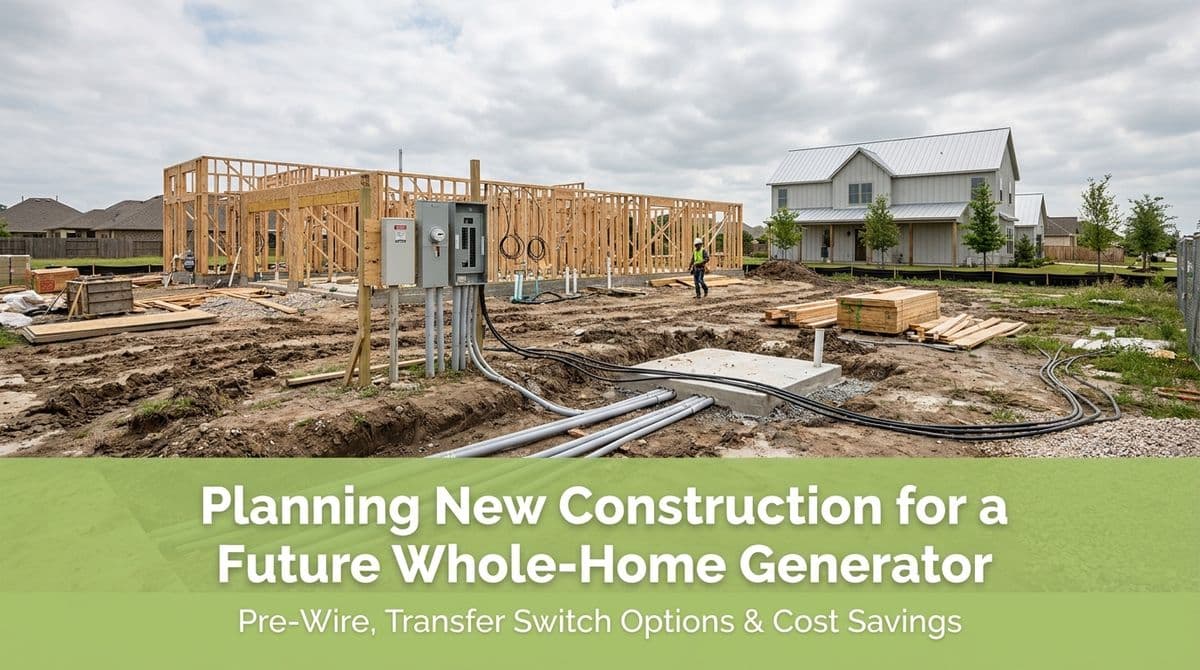
Planning Ahead for a Whole‑Home Generator in New Construction
We recently got a call from a customer — let’s call him Jason — who was in the middle of roughing in the electrical on his new home. Jason didn’t want to install a whole-home Generac generator right away, but he did want the house ready so he could add it a few months after closing without tearing into fresh walls and siding.
Jason had been researching online and saw a Generac meter base that’s “generator-ready.” His big question to us was: should he install that specialized meter socket now, or should we pre-wire a separate transfer switch and keep his options open?
That conversation is one we have often on new construction projects, and it’s a smart one to have early. So we thought we’d walk through the same advice we gave Jason — how to plan for a future whole-home generator, what transfer switch options look like, and where you can actually save money by thinking ahead.
Why It Pays to Plan for a Future Generator Now
When we talked through Jason’s plans, his main goal was efficiency: “I don’t want to pay twice or tear anything back open later.” That’s exactly the right mindset during new construction.
By planning ahead for a future whole-home generator, you can:
- Avoid rework: No cutting drywall, re-routing conduit, or re-pulling feeders later.
- Control your timeline: Close on the house now, add the generator when the budget allows.
- Pass inspections smoothly: The house is fully code-compliant even before the generator is installed.
- Protect curb appeal: We can plan clean, logical locations for the transfer switch, conduit runs, and generator pad from day one.
All of that starts with one key decision: how to prep the electrical service for a generator that isn’t there yet.
Option 1: Generator‑Ready Meter Base with Integrated Transfer Switch
Jason had his eye on a Generac meter base that includes an integrated transfer mechanism. The idea is appealing: you replace the standard meter socket with a “smart” one that’s designed to accept a generator connection later.
Here are the main upsides and downsides we walked him through.
Pros of a Generator‑Ready Meter Base
- Compact package: Meter and transfer mechanism are in one piece of equipment.
- Clean exterior look: Fewer separate boxes on the outside wall.
- Future-friendly: In theory, once it’s in, it’s ready for a compatible generator down the road.
Cons of a Generator‑Ready Meter Base
- Higher material cost: As we told Jason, we’ve only installed this style a handful of times because they are significantly more expensive than a standard meter plus separate transfer switch.
- Less flexibility: You’re often locked into a specific brand and style of generator and controls.
- Service complexity: If something fails, the device handling both metering and transfer can be more involved to troubleshoot or replace.
For some homeowners and builders, that integrated approach still makes sense, especially where space is tight or the utility has particular meter requirements. But it’s not the only way — or usually the most cost-effective way — to be “generator ready.”
Option 2: Standard Meter with a Separate Transfer Switch (What We Usually Recommend)
What we recommended to Jason — and what we usually do on new construction — is a more traditional setup: a standard meter base feeding a separate automatic transfer switch (ATS), which then feeds the main panel or panels.
Here’s how that layout typically works on a new build:
- Meter to transfer switch: We run your service conductors from the utility meter into a dedicated transfer switch mounted nearby.
- Transfer switch to panels: From there, we feed your main load center(s) — the house functions just like normal, on utility power.
- Future generator connection: When you’re ready for the generator, we come back, set the generator outside, and make the connections between the generator and the transfer switch that’s already in place.
Why This Approach Often Saves Money
When we broke down costs with Jason, a few things stood out:
- Lower up-front equipment cost: A standard meter and a conventional transfer switch are usually less expensive than a specialty generator-ready meter base.
- Labor is more efficient now: While the walls are open and trenches are going in anyway, we can run the heavy conductors to the future generator location for less labor than retrofitting later.
- Future generator installation is streamlined: When Jason calls us back in 4–5 months, the hardest part is already done. We’ll just set the generator, connect it to the pre-installed transfer switch, and handle startup and testing.
On top of that, this setup tends to keep your options open. If you decide on a different generator size or even a different brand later, the transfer switch can often be selected to accommodate that flexibility.
Key Pre‑Wiring Decisions for New Construction
If you’re in the planning or rough-in stage like Jason was, here are the big pre-wiring decisions to settle with your electrician:
- Transfer switch type: Whole-house automatic transfer switch vs. a smaller switch serving essential loads only.
- Location: Where will the transfer switch go relative to the meter and your main panel? We aim for short, direct runs to minimize material and voltage drop.
- Conduit runs: It’s wise to stub conduit from the transfer switch to the future generator pad now, even if the generator is months away.
- Generator sizing assumptions: Even if you haven’t picked a model, we want a ballpark size (kW range) so we can size conductors correctly.
Getting these details right during construction can easily shave hours of labor — and headaches — off the future generator install.
How to Decide What’s Right for Your New Home
When we wrapped up our call with Jason, we offered what we always recommend: we come out, look at the plans and the rough-in, and provide a quote for both approaches — integrated meter base vs. standard meter with separate transfer switch.
Every home and utility service is a little different, but in most cases we find homeowners can:
- Use a standard meter
- Install a separate transfer switch during construction
- Pre-run conduit and conductors to a future generator location
- Then add the generator itself later with minimal disruption
If you’re building a home now and thinking, “I might want a whole-home generator down the road,” this is the perfect time to talk through your options. We’re always happy to look at your plans, explain costs in plain language, and set you up so that when you’re ready for backup power, the hard part is already done.